
What Is Contemporary Textile Art? An Artist’s Perspective
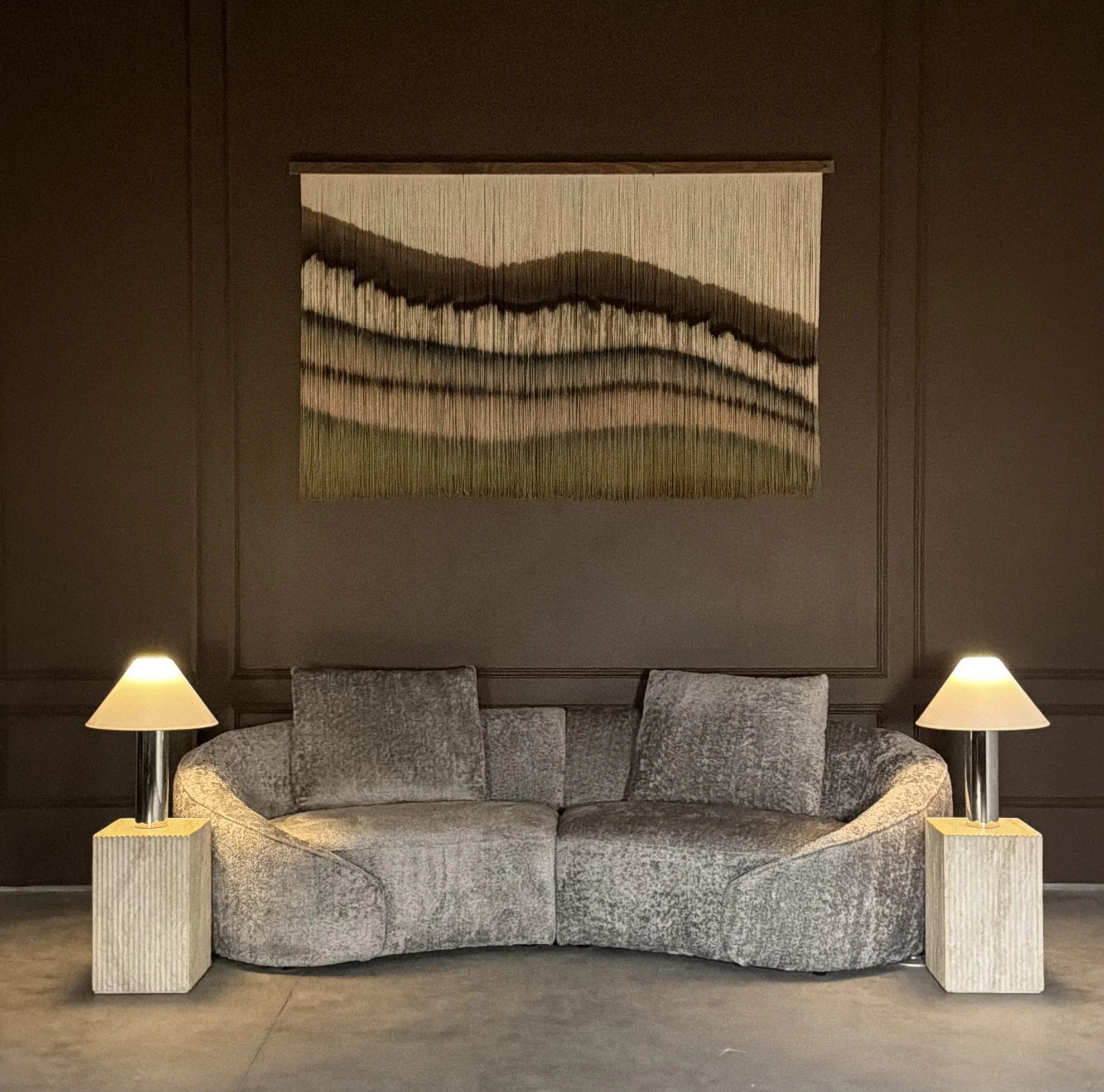
Contemporary textile art is art created by living artists using fiber, textiles, or textile processes as an essential part of their medium. It can take the form of wall-based artwork, sculpture, installation, and architectural-scale work, drawing on processes such as dyeing, weaving, knotting, stitching, suspension, construction, and other forms of fiber manipulation.
In other words, contemporary textile artists are taking materials and techniques with centuries of history and asking what they can become now.
And I think that last part is important.
Contemporary textile art isn't simply traditional textile work made today. Artists are taking the history, knowledge, and physicality of textiles and pushing them into new conversations around abstraction, sculpture, architecture, materiality, movement, identity, and space.
That can mean a woven work that functions like an abstract painting. It can mean fiber extending away from the wall and becoming sculpture. It can mean an installation that completely surrounds the viewer. In my own practice, it has meant suspending thousands of individually dyed strands so that color can exist almost like paint, but without a fixed canvas. It has also meant combining fiber with metal and acrylic structures, allowing textile to become increasingly sculptural and architectural.
That's what makes the field so difficult to define by material alone.
The question isn't simply, “What is it made from?”
The more interesting question is, “What is the artist making the material do?”
An Ancient Material in a Very Contemporary World
Textile art is particularly meaningful to me right now because it is anything but new.
Humans have been working with fiber for centuries, transforming it into functional, decorative, ceremonial, and artistic objects. There is an enormous history of knowledge embedded within textile making: understanding tension, repetition, pattern, color, construction, touch, and material.
Contemporary artists inherit that history, whether they follow traditional textile processes closely or intentionally break away from them.
At the same time, we're living through an extraordinary technological shift.
Artificial intelligence can generate an image in seconds. Digital tools allow us to visualize an entire room before anything physical exists. Objects can be designed, reproduced, and distributed with increasing speed.
I use some of those technologies myself, so I don't see this as a rejection of them.
If anything, I think technology has made me more aware of what the handmade object represents.
A handmade artwork contains evidence of decisions.
There is experimentation. Repetition. Material knowledge. Physical labor. Imperfection. Time.
And importantly, resistance.
Physical materials don't always do what you tell them to do.
In my studio, fibers have to be handled individually. Color has to be mixed and applied. Dye travels differently depending on the fiber. Gravity changes a composition. A material twists. Something dries differently than expected. Sometimes an idea I've spent days developing simply doesn't work.
There is no command I can give the material that guarantees the outcome.
After twelve years, I've learned an enormous amount about controlling my materials, but I've also learned when to stop trying to control them.
That tension has become part of the work itself.
Why I Think We Are Drawn to Materiality Again
I don't think the renewed interest in textile art within contemporary interiors is accidental.
We're surrounded by increasingly smooth experiences: screens, glass, digital images, manufactured surfaces, and objects engineered for consistency.
Textile gives us almost the opposite experience.
You can see the fibers.
You understand instinctively that the surface has texture.
You can imagine what it might feel like even when you're standing several feet away.
You see where one strand behaves differently from another.
And when textile is used as fine art rather than simply as upholstery, rugs, or decorative fabric, something familiar is suddenly experienced in an unfamiliar way.
I think that creates a very human response. Perfectly imperfect.
There is also a softness to textile that can be especially powerful within contemporary architecture. A room may contain stone, glass, plaster, metal, wood, and hard architectural lines. Introducing fiber doesn't necessarily make that environment less sophisticated or less contemporary. It can create contrast.
Soft against hard.
Movement against structure.
Organic material against precise architecture.
That tension is much more interesting to me than the idea that textile art belongs to a particular decorating style.
It doesn't.
Textile is a medium, not an aesthetic.
A textile artwork can be minimal, conceptual, architectural, organic, monochromatic, highly colorful, restrained, monumental, or incredibly intricate. It can exist in a museum, a gallery, a private residence, a hotel, an airport, or a public space.
The fiber doesn't determine the style.
The artist does.
What Twelve Years of Working With Fiber Has Taught Me
My own relationship with textile began with a problem.
Twelve years ago, shortly after moving from Los Angeles to Dallas, we were living in a rental house with a dining-room wall that felt enormous compared with the spaces we'd had in California.
I knew it needed a large piece of artwork.
The problem was that my taste in art and my budget for art at the time did not align.
So I decided I would make something.
I wasn't an artist. I was simply creative and comfortable figuring things out.
My original plan was to buy a large canvas and paint something, but I couldn't find a canvas in the dimensions I wanted. So I started thinking about how I could construct one myself.
I connected wooden dowels with duct tape and walked up and down the aisles of a craft store looking for something I could attach to them. I considered cutting fabric and shredding sheets before eventually experimenting with yarn.
Then I was in my backyard using diluted paints and dyes on individual suspended strands.
It was incredibly rudimentary.
But something happened when I hung that first piece on the wall.
It moved.
The individual strands weren't trapped against a surface. They responded to air. They separated. They came back together. The color changed depending on how the fibers fell.
It wasn't quite a painting. It wasn't a tapestry. It wasn't sculpture in the traditional sense.
I didn't have the vocabulary for it yet.
I just knew I hadn't seen artwork behave quite like that before.
And I couldn't stop.
When Fiber Becomes Movement
That first experiment eventually became what I call Canvas with Movement, a body of work I've continued developing for more than a decade.
I began treating individual strands almost like brushstrokes.
Instead of putting paint onto canvas, I could put color directly into the fibers. Hundreds or thousands of strands together could create a composition, but unlike paint on a fixed surface, the composition was never completely still.
Air became part of it.
Gravity became part of it.
Light became part of it.
Eventually I realized the viewer was part of it too.
Someone walking past the artwork can create just enough air movement to shift the strands. When viewed from the side, the work looks completely different than it does straight on. Morning light can reveal something that disappears later in the day.
That changed the way I thought about artwork within a room.
I stopped thinking only about the wall.
I started thinking about the space in front of the wall.
Where is the doorway? Where does someone enter? Can the artwork be seen from another room? Will someone walk beside it? What happens when natural light comes through the window? How does the work relate to the ceiling height?
Those questions have become increasingly important as my work has grown in scale.
At a certain point, textile art stops simply occupying architecture.
It begins interacting with it.
Pushing Textile Beyond What I Already Know
That same curiosity eventually pushed me beyond Canvas with Movement.
If suspended fiber could behave like a painting, I began wondering what would happen if I gave it structure.
What if fiber moved through acrylic forms?
What if a strand became part of a repeated sculptural composition?
What happens when the softness of textile meets the precision and reflectivity of metal?
Those questions have led me into other bodies of work, including Squares & Strands, Refined Canvases, and Columns.
Each looks different, but they're connected by the same investigation.
I'm interested in the contrast between soft and hard, controlled and uncontrolled, structured and organic.
I'm also interested in what happens when textile begins occupying more physical space.
A fiber doesn't have to lie flat against a wall. It can hang. It can move through something. It can cast a shadow. It can extend into the room. It can become part of a sculptural structure.
And I still feel like there is enormous territory left to explore.
Why Contemporary Textile Art Matters
For me, the importance of contemporary textile art isn't that fiber has suddenly become fashionable again.
It's almost the opposite.
It matters because this is an extraordinarily old material language that living artists are still finding new ways to speak.
There's continuity in that.
An artist today can work with fiber while participating in a history that stretches back centuries, but the resulting artwork can still feel completely of this moment.
And perhaps our increasingly digital lives make that physical lineage easier to appreciate.
When you stand in front of a textile artwork, you're looking at material that has been physically manipulated by another person.
Someone touched it.
Someone made decisions about it.
Someone spent time with it.
And in many cases, you can actually see that time.
I think we're going to become increasingly sensitive to that distinction.
Not because handmade work is somehow in competition with technology, but because the more effortless digital creation becomes, the more noticeable physical effort may become.
The human hand leaves evidence.
Textile holds onto that evidence particularly well.
What Contemporary Textile Art Means to Me
After twelve years of working with fiber, I've become less interested in defining textile art according to what it has traditionally been and more interested in discovering what it hasn't been yet.
That's ultimately how I think about contemporary textile art.
It respects an extraordinary material history without being confined by it.
It allows artists working today to take fiber into painting, sculpture, installation, architecture, abstraction, and places we may not have language for yet.
My own practice began with yarn, wooden dowels, duct tape, dye, and a blank wall.
Twelve years later, I'm still asking essentially the same question:
What else can fiber do?
And I think that's where contemporary textile art becomes most exciting.
Not when we simply preserve what has already been done with textile, but when living artists use that history as a foundation for making something we haven't seen before.
Frequently Asked Questions About Contemporary Textile Art
What is contemporary textile art?
Contemporary textile art is art created by living artists who use fiber, textiles, or textile-based processes as an essential part of their medium. It can include wall-based artwork, sculpture, installation, and architectural-scale work using techniques such as dyeing, weaving, knotting, stitching, suspension, and fiber manipulation.
Contemporary textile artists often build upon centuries of textile traditions while using those materials to explore current ideas around abstraction, sculpture, movement, materiality, identity, and architecture.
What is the difference between textile art and fiber art?
Textile art and fiber art overlap considerably, and the terms are often used interchangeably.
Fiber art broadly describes artwork in which natural or synthetic fibers are a primary material. Textile art generally refers to artwork rooted in textile materials, processes, structures, or traditions.
Many artists could accurately be described by both terms. I describe my own practice as contemporary textile art because fiber is the foundation of my work, but my practice extends into painting, sculpture, movement, installation, and architecture.
Is textile art considered fine art?
Yes. Textile and fiber-based works are exhibited and collected by museums, galleries, institutions, and private collectors around the world.
Although textiles have historically been separated from painting and sculpture and frequently categorized as craft or decorative art, contemporary artists have continually challenged those distinctions. Today, textile art can encompass abstraction, sculpture, installation, conceptual work, and large-scale architectural commissions.
Is textile art the same as tapestry?
No. Tapestry is one particular textile tradition and method of construction. I figured this out after years of having zero clue what to call my artwork. People would refer to my art as. “tapestries” and so I just went with that for a w while. I coined the phrase “Canvas With Movement” and eventually trademarked the term.
Contemporary textile art encompasses a much broader range of approaches. Artists may weave, dye, knot, stitch, suspend, sculpt, layer, construct, or otherwise manipulate fiber and textile materials. A contemporary textile artwork may hang on a wall, extend into three-dimensional space, or become an architectural-scale installation.
Can contemporary textile art be large scale?
Yes. Contemporary textile art can range from intimate works to monumental installations. This is where I shine. I am known for my age scale works. However, I have created more recent series works for clients and projects where wall space is limited but impact is still essential.
Fiber is particularly interesting at a large scale because it can interact with architecture, light, shadow, movement, ceiling height, viewing distance, and the way people physically move through a space. In my own practice, scale has become an important part of exploring the relationship between textile artwork and the architecture surrounding it.
Can contemporary textile art be commissioned?
Yes. Contemporary textile artists may create commissioned artwork for private collectors, interior designers, art advisors, architects, hospitality projects, commercial environments, and public spaces. I love working with art collectors, curators and designers to create the perfect piece of artwork for a space or project. You can learn more about my commission process here.
A site-specific textile art commission can respond to the scale and architecture of a particular space while remaining true to the artist's established materials, process, and visual language.
Who is Lauren Williams?
Lauren Williams is a contemporary textile artist based in Texas whose work explores the relationship between fiber, color, movement, materiality, and architectural scale. Since beginning her practice in 2014, Williams has developed multiple bodies of textile-based work, including Canvas with Movement, Refined Canvases, Squares & Strands, and Columns. Her work includes large-scale and commissioned textile artworks created for collectors, interior designers, galleries, hospitality projects, and architectural spaces.